Schools assess students’ learning progress and their needs in lots of different ways. Standardised test results are just one way of assessing students, and scores should be looked at and interpreted along with other assessment methods to help you build an overall picture of your child’s learning. Please remember that these tests are just a snapshot of performance on any particular day. When talking to your child’s teacher about their progress, they will take all elements of your child’s learning into consideration.
What do standardised tests measure?
Standardised tests in English reading and maths measure your child’s achievement compared to other children in all schools at the same class or age level. The standardised test in Irish reading measures a child’s achievement compared to other children in Irish-speaking schools at the same class or age level.
What do my child’s test scores mean?
The teacher may use STen scores to tell you how your child did in the tests. STen scores go from 1 to 10.
The table below describes what the different STen scores tell you about your child’s achievement in the tests.
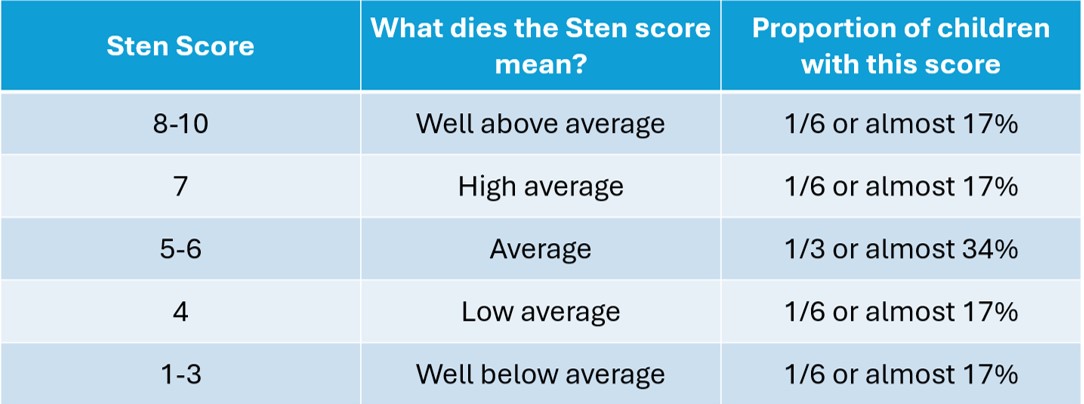
If your child’s STen score is between 5 and 6 for example, you will know that his/her performance on the test is average. The table shows that about one in every three children in Ireland have STen scores in this range. You can also see that some children have STen scores above and below the average. Scores for children with English as an additional language may not always reflect progress being made in class. Similar care is needed when interpreting scores for children with special educational needs.
If my child’s score is low, what does this tell me?
A STen score of 1, 2 or 3 suggests that your child may have difficulties in one of the areas tested. Other assessments may be used to determine if this is the case.
Information about your child’s learning and development at home e.g. homework, may also be helpful to the teacher. Teachers at your child’s school may decide that your child would benefit from extra support. If so, your child’s teacher will talk to you about this.
If my child’s score is high, what does this tell me?
A STen score of 8, 9 or 10 may suggest that your child is a high achiever in the area tested. As with low scores, one high score is not enough to confirm this. Your child’s teacher will use information from other classroom assessments to understand more clearly how well your child is doing in maths, English reading or Irish reading. The teacher may talk to you about extra learning opportunities that you and the school can provide for your child.
What can affect my child’s test score?
As with other tests your child does in school, the score on a standardised test can be affected by how he/she feels on the test day or by worry or excitement about a home or school
event. This means that each test score is an indication of your child’s achievement. Remember that you play an important role in encouraging and supporting your child regardless of test results. You may like to arrange to meet with your child’s teacher if you have any concerns about his/ her scores.
How can I help my child?
The NCCA has developed some online resources to help you to support your child’s learning in primary school. Many of these are available in various languages and new resources are regularly added to the parents’ page at www.ncca.ie/parents. Take a look at the resources for your child’s class.
How accurate are the test scores?
While the tests are designed to give good estimates of students’ achievement, you should bear in mind that there is a margin of error around every child’s test score. This is because a test represents a single “snapshot” of achievement, and a child’s result is likely to vary a little depending on how they are feeling on the day. For example, how much energy do they have; are they nervous; are they feeling hungry or ill? Their result will also vary slightly based on the particular test questions that they see. For example, a child who loves sport might perform a bit better than usual when reading a text about a football player because they are more familiar with the words used. It is useful to always keep this margin of error in mind when you are trying to understand your child’s test score. It might be helpful to think of a standardised test score as just one piece in the “jigsaw” of information about your child’s learning.